
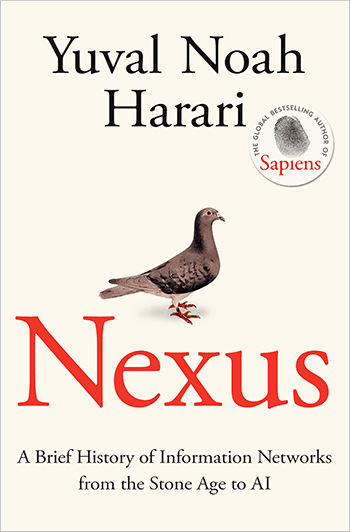
Yuval Noah Harari is good at making familiar arrangements look strange. Money, borders and institutions feel solid in everyday life. His books ask what allows people who will never meet to trust them and act together. That question connects Sapiens with Nexus more clearly than a label such as “a book about the past” or “a book about AI” does. ## Start with Sapiens for the broad view Sapiens follows the development of human societies across a very large stretch of time. A central argument concerns the role of shared beliefs in organising cooperation. It is an inviting starting point for readers who enjoy moving between history, economics and questions about human behaviour. The scale is also a reason to pause. A broad narrative can make messy events seem tidier than they were. Keep a note of claims you would like to investigate in a more specialised history, rather than treating the book as the final word on each subject. ## Then consider Nexus Published in 2024, Nexus turns towards information networks and the relationship between information, truth and power. AI enters that discussion as part of a longer argument about how societies organise knowledge and authority. For a reader, the useful move is to ask what a network rewards. Does it help errors get corrected? Does it favour a compelling story over a careful account? These questions are worth carrying into the news feed long after the book is closed. ## You do not have to agree with every leap Harari's appeal lies partly in his willingness to join distant subjects. That can make a book stimulating without making every comparison equally convincing. When an analogy seems particularly neat, ask what it leaves out. Who had different experiences? What evidence would change the argument? This is a better way to read a big-idea author than either accepting the whole package or dismissing it after one disagreement. ## A reading route Choose Sapiens if your curiosity begins with how human societies developed. Choose Nexus if the immediate question is how information systems shape collective decisions. Read a sample of either before committing; both reward the reader who enjoys an argument as much as a story. This spotlight discusses Harari's published work. It is not an interview or an account of his private writing routine. Sources: the author's official book pages, ynharari.com/book/sapiens/ and ynharari.com/book/nexus/.
Author SpotlightIssue #44
Reading Yuval Noah Harari: From Sapiens to Nexus
How Harari’s questions about shared stories lead into his writing on information and AI, plus a sensible place to start reading.
📅 May 20, 2026🕐 2 min read
AuthorHistoryAIHarari