
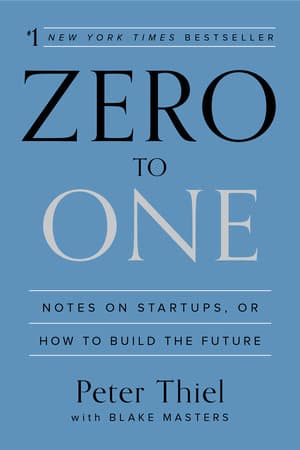
You do not need to finish thirty business books before starting a company. It is usually more useful to choose one that speaks to the problem on your desk. These six cover different stages of building a business. They are not a compulsory syllabus, and there is no age by which you are supposed to have read them. ## 1. Zero to One — Peter Thiel with Blake Masters Pick this up when your idea looks suspiciously similar to everything already available. Its central challenge is to think about what your business can do differently. It is a provocative strategy book rather than a launch checklist. Test its arguments against your market; a useful local business does not have to become a venture-scale technology company. ## 2. The Lean Startup — Eric Ries Read this when a team is building on assumptions it has not tested. Ries describes learning through experiments and feedback. Before borrowing the language of minimum viable products, write down the uncertainty you actually want to resolve. A rough product with no learning goal is simply a rough product. ## 3. Traction — Gabriel Weinberg and Justin Mares Choose this when the product exists but customers are not arriving. The authors examine nineteen acquisition channels and a process for exploring them. It is a reminder to investigate distribution early. Particular platforms change; the habit of comparing small tests is more durable than any single channel recommendation. ## 4. High Output Management — Andrew S. Grove This is the practical choice when your work increasingly depends on other people doing their jobs well. Grove discusses organising work and developing employees. Read it alongside a real management problem: unclear responsibilities, an unhelpful meeting or a task that keeps getting stuck. The industrial examples need translation into your own setting. ## 5. Good to Great — Jim Collins Collins examines why some established companies made a sustained improvement while comparison companies did not. It offers material for thinking about leadership, people and focus. The important word is “established”: a company study is not automatically a reliable recipe for a new startup. Use the questions to challenge decisions, not to predict success. ## 6. Start with Why — Simon Sinek Reach for this when you can describe what you sell but struggle to explain why anyone should care. Sinek's framework puts purpose at the centre of communication. That can help clarify a message, but a persuasive purpose still needs a product that works and customers willing to use it. ## A shorter route through the shelf Testing demand? Begin with The Lean Startup. Finding customers? Try Traction. Managing your first team? Choose High Output Management. Keep the other books for the questions they are best equipped to address. After a chapter, write down one decision it could change. If you cannot name one, it may be the wrong book for this stage—not a failure to read enough. Source notes: publisher descriptions from Penguin Random House for Zero to One, Traction and High Output Management; theleanstartup.com/principles; jimcollins.com/books.html; simonsinek.com/books/start-with-why.
Reading ListIssue #42
Six Business Books to Match the Problem You Are Solving
A focused reading list for testing an idea, finding customers and managing a team—with a reason to choose each book and a limit to keep in mind.
📅 May 10, 2026🕐 3 min read
EntrepreneurshipBusinessLists